Index
We Need Needles In Yellow Before The Planet Breaks Down
22 September 2026
Peter Coffee
In many situations, people seem to crave a single number—or even just an on-or-off warning light—that tells them if things are all right. The smart watches on our wrists are now claimed to provide a single “Readiness” number, despite “a backdrop of claims about the data that are not backed up by adequate evidence, marketing way out in front of whatever limited data exists, and not being transparent about their readiness score algorithms.” The clearly labeled gauges in older automobiles (I used to know my coolant temperature, oil temperature and oil pressure, and electrical system bus voltage, most of them in standard units of measure) are now subsumed by vague warning lights including the might-be-almost-anything “Check Engine.” It’s a comparably bad idea to attempt simplification of an entire planet’s condition—let alone to project its future state—into a simple label like “global warming” or a single number like “1.5ºC.”
It’s somewhat encouraging that “global warming” has mostly surrendered the spotlight of concern – now focused on the less simplistic, more useful label of “climate change.” The relabeling has been dramatic: in April 2007, shortly after the movie “An Inconvenient Truth” won two Academy Awards, global search traffic for the phrase “global warming” (per Google Trends) reached an all-time high – while searches for “climate change” were only about one-eighth as common. Fifteen years later, searches for “climate change” spiked to twice the level that “global warming” had ever achieved, and since then it has consistently dominated; notably, there’s a dramatic spike every April when Google’s “doodle” on April 22 (Earth Day) makes it easy for people to ask for more.
But even “climate change” is too much of a “check engine” light, compared to the more specific and measurable indicators of the “Planetary Boundaries” framework that is used by both the Stockholm Resilience Center and the Potsdam Institute for Climate Impact Research. When I mentioned the “boundaries” in a note here last December, it was in a positive context of ozone-layer recovery; at that time, though, I had to include the less good news that stratospheric ozone was one of a shrinking number of boundary conditions that were still in their safe zones. This week, the Postsdam group released the latest update to its Planetary Health Check, whose headline finding is that only two boundary conditions (ozone layer and atmospheric aerosol loading) are still in the green. Ocean acidification most recently ascended into the yellow “zone of increasing risk.”
I personally prefer the “radar plot” format used by the Stockholm team in its reports, but the latest numbers are those from Potsdam whose bar chart I reproduce below:
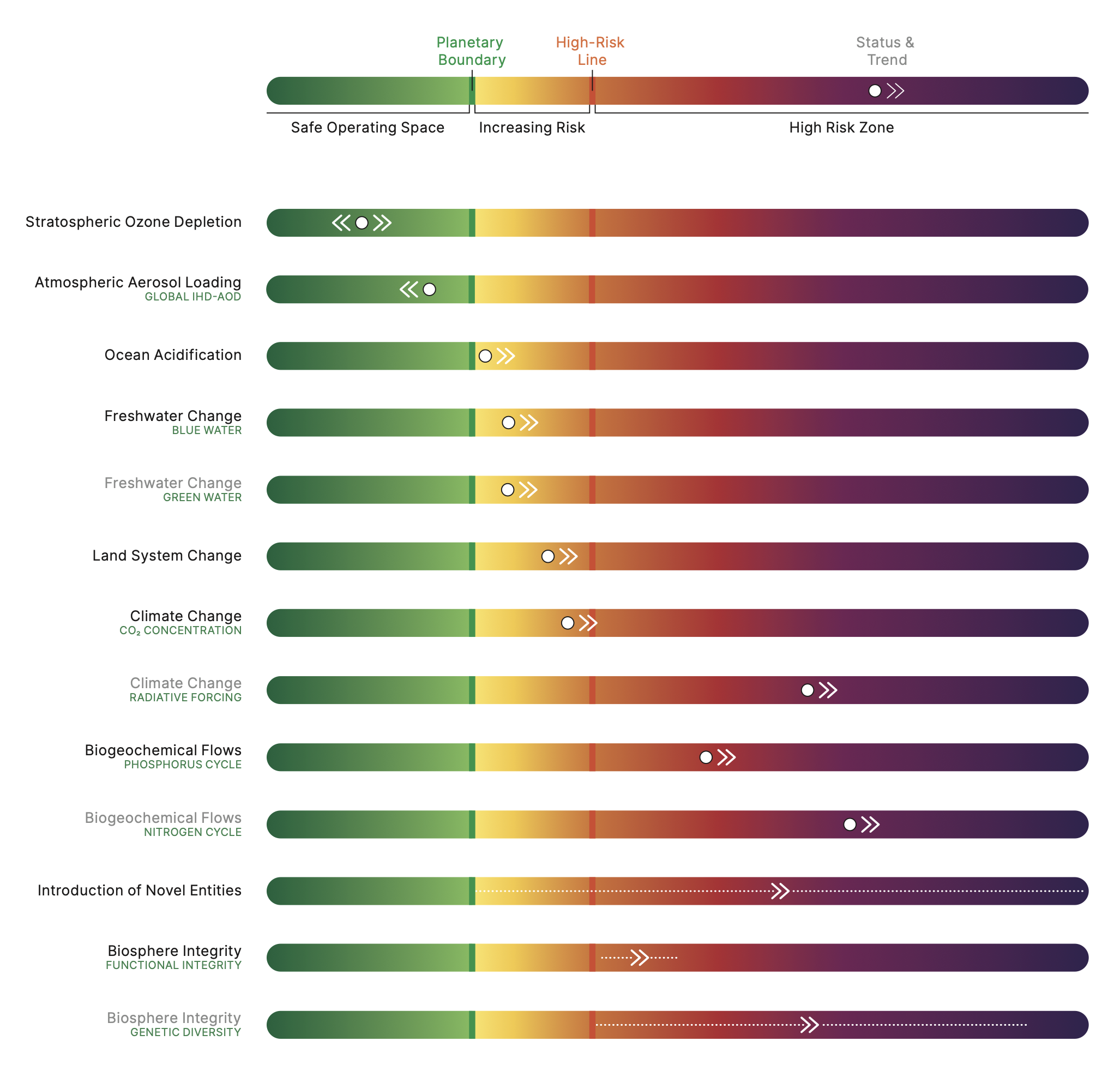
Additionally, the statement accompanying this week’s Potsdam report makes the key point that (as recently noted here) there is danger in any notion that we can define success as “getting back into the green” for any of the bars above that are not in that zone: as stated by the report’s lead author, Boris Sakschewski,
The diagnosis is unambiguous. Pressure is rising across every Planetary Boundary already outside the safe operating space. It means that the risk of large-scale, persistent and potentially irreversible change is increasing, while our margin for error in tackling these problems is shrinking… Our path to net zero emissions relies on functioning carbon sinks. Current observations raise the alarm that our planet may be losing its buffering capacity against the increasing pressures we’re putting on it.
I’m a big fan of having measures whose trends we can recognize, reported in units with physical meaning, alerting us to need for preventive action – and only summarized in composites whose calculation is fully disclosed, and whose value in guiding decisions has been confirmed. I’m not a fan of relying on idiot lights that only tell us when something is broken, especially if it’s busted beyond our ability to repair.