
Index
Boundary Conditions – Sometimes There’s Good News
30 December 2025
Peter Coffee
Responding to last week’s note on arctic observations and the solar panel life cycle, a good friend said that she found it “both interesting and discouraging.” The ‘interesting’ is good to hear – and I do apologize for the length of that piece, even if she did apparently get all the way through it.
I’ll try hard to keep these notes under 800 words, because it’s not as if any of them will ever be the last word on anything. The ‘discouraging,’ though, is something I’ll try even harder to avoid. I offered her my hope that ‘interesting’ can power us through the rough road of ‘discouraging’—to reach the faster track of ‘imaginable’—but that’s not good enough.
I need to be sure that whenever possible, examples of achievable improvement will be offered to fuel that effort. Let’s start now: among the items of good news during 2025 was a March 5 bulletin from MIT that “the Antarctic ozone layer is healing, as a direct result of global efforts to reduce ozone-depleting substances…[a] new study is the first to show, with high statistical confidence, that this recovery is due primarily to the reduction of ozone-depleting substances, versus other influences such as natural weather variability or increased greenhouse gas emissions to the stratosphere.”
Double underline that key conclusion. Previous studies, the MIT bulletin notes, “showed large uncertainties regarding how much of this recovery was due to concerted efforts to reduce ozone-depleting substances, or if the shrinking ozone hole was a result of other ‘forcings,’ such as year-to-year weather variability from El Niño, La Niña, and the polar vortex.” A ‘fingerprint’ in the data, arising from a comparison of simulations to actual observations, allowed the team to “say with 95 percent confidence that ozone recovery was due mainly to reductions in ozone-depleting substances.”
As further stated in the journal Nature, the team asserted that their results “provide robust statistical and physical evidence that actions taken under the Montreal Protocol to reduce [ozone-depleting substances] are indeed resulting in the beginning of Antarctic ozone recovery.”
This is consistent with an engaging data graphic that was shared in 2023 at Science Advances depicting the planet’s state in terms of nine “boundary processes” – with the stratospheric ozone layer being one of the most literal ‘boundaries’ in question. You probably suspected that this note would not be entirely good news, and I'm sorry to have to add that the state of the ozone layer is one of only three boundaries that were shown to be in the “safe operating space” as of that date.
The most recent update of that graphic from the Stockholm Resilience Center is reproduced below under terms of its Creative Commons License; as of now, ozone is still in the green, but in the time since the earliest version of this analysis—in 2009—there have been “boundary crossings” in processes including ocean acidification; freshwater use; and “land system change” (defined as “transformation of natural landscapes, such as through deforestation and urbanization” such that “remaining forest areas in tropical, boreal, and temperate biomes have fallen below safe levels”).
That reference to deforestation follows my mention of planting trees as one of the elements of the board game “Daybreak,” in notes on the game two weeks ago: there will be more to come on that subject, not on a game board but in the real-life rain forest of the Pacific Northwest, in a note sometime soon. For now, these ~600 words will help me reduce my average imposition on your time, so I think I’ll stop here.
The length of the wedges symbolizes what the current state of the corresponding process is, in relation to the distance from the planetary boundary (end of the green area) and the Holocene baseline (origin of the diagram). The color symbolizes the risks associated with each.
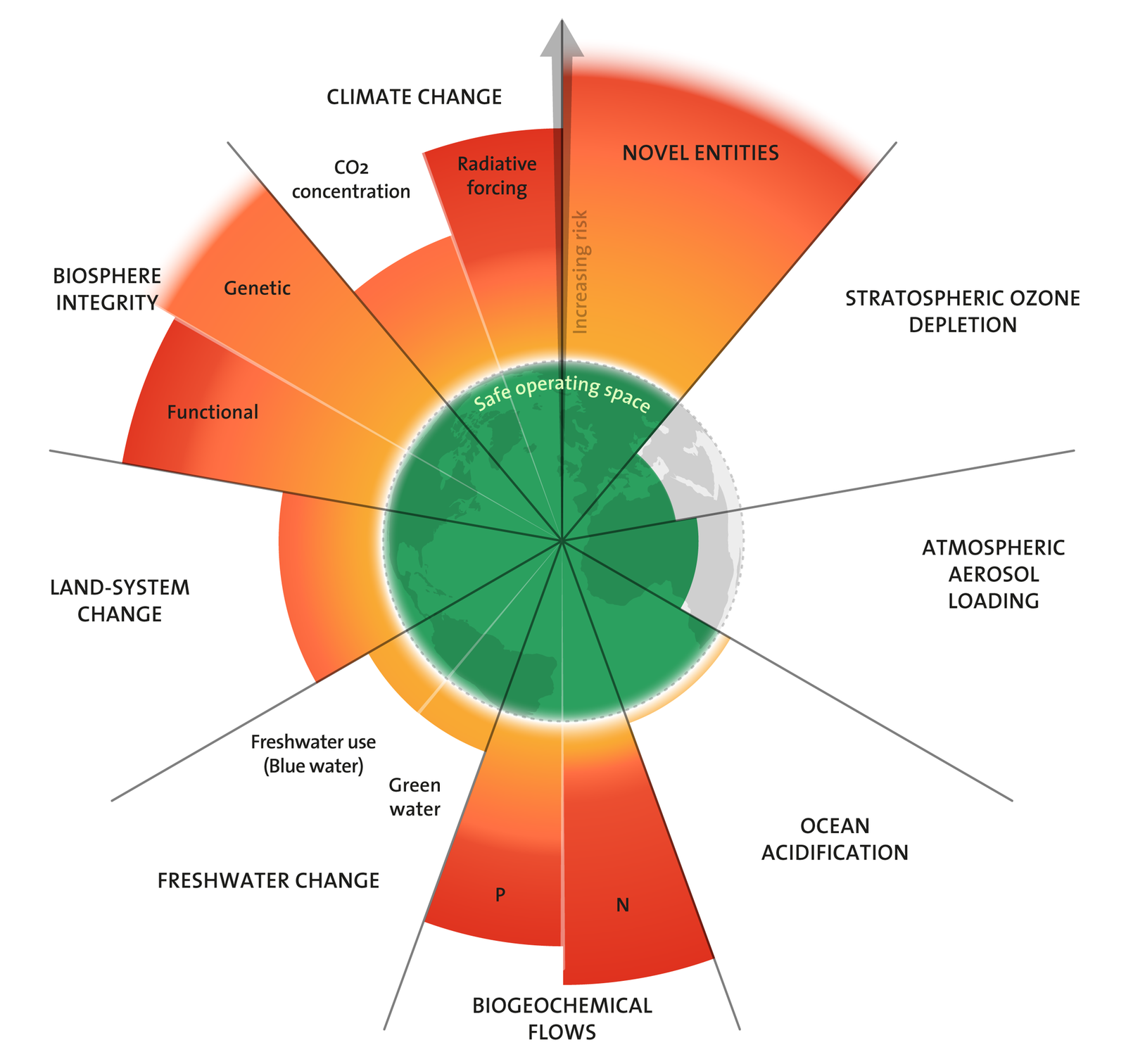
Azote for Stockholm Resilience Centre, based on analysis in Sakschewski and
Caesar et al. 2025
