
Index
Let’s Speak For The Trees
6 January 2026
Peter Coffee
Last week, I said that there would be more to come on the subject of trees and their role in carbon sequestration. My timetable for talking about this got pulled forward by last month’s postponement of EU enforcement of a Deforestation Regulation, originally adopted in April of 2023 – with compliance requirements now delayed until 30 December 2026.
This EU regulation won’t ban any product entirely. Rather, to quote from the references above,
Companies will only be allowed to sell products in the EU if the supplier of the product has issued a so-called “due diligence” statement confirming that the product does not come from deforested land or has led to forest degradation, including of irreplaceable primary forests, after 31 December 2020. [My boldfacing added to any quotations used here, both above and in what follows]
An EU participant in the process puts this in everyday terms that make this feel, correctly and usefully, like a matter of every person’s individual responsibility:
Until today, our supermarket shelves have all too often been filled with products covered in the ashes of burned-down rainforests and irreversibly destroyed ecosystems and which had wiped out the livelihoods of indigenous people. All too often, this happened without consumers knowing about it. I am relieved that European consumers can now rest assured that they will no longer be unwittingly complicit in deforestation when they eat their bar of chocolate or enjoy a well-deserved coffee.
This is about nothing more, but also nothing less, than surfacing the choices we make and the consequences that they can have.
As noted here a few weeks ago, though, sometimes a personal understanding of a global impact requires an effort to make the numbers comprehensible. Hectares per year are difficult to visualize, but “football field every three seconds” perhaps provides a more urgency-inspiring measure.
Somewhere in between, and hitting me hard as measures of magnitude, are some figures from the United Nations Food and Agriculture Organization [PDF]:
The world has lost a net area of 178 million hectares of forest since 1990, which is an area about the size of Libya. [For people like me who would have to look at a map to get a handle on that, the EU’s initial announcement of the 2023 action—linked above—rephrases this to “An area larger than the EU was lost to deforestation between 1990 and 2020, with EU consumption causing around 10% of losses.”]
The world’s total growing stock of trees decreased slightly, from 560 billion m3 in 1990 to 557 billion m3 in 2020, due to a net decrease in forest area.
Most forest carbon is found in the living biomass (44 percent) and soil organic matter (45 percent), with the remainder in dead wood and litter. The total carbon stock in forests decreased from 668 gigatonnes in 1990 to 662 gigatonnes in 2020.
The latter two bullet points may seem like small reductions, percentage-wise: that would be an unfortunate take-away, since there’s a clear need to be increasing the planet’s carbon-sequestration capacity. As estimated by Australia’s Commonwealth Scientific and Industrial Research Organisation this past November,
Global CO₂ emissions from the use of fossil fuels continue to increase. They are set to rise by 1.1% in 2025, on top of a similar rise in 2024. All fossil fuels are contributing to the rise. Emissions from natural gas grew 1.3%, followed by oil (up 1.0%) and coal (up 0.8%). Altogether, fossil fuels produced 38.1 billion tonnes of CO₂ in 2025.
Further, it may be a distraction to focus only on emissions from fossil fuel combustion. As noted recently by researchers at the Luskin Center for Innovation at UCLA,
As demand for gasoline declines, oil and gas companies are betting their future on plastic. What once powered our cars is now being refined, cracked and polymerized into bottles, packaging and single-use products that will outlive us all…
A key point is that even if the hydrocarbons aren’t being burned, their continued extraction and processing has side effects on public health:
Living near oil and gas development is linked to a wide array of health harms: respiratory disease, cardiovascular illness, adverse birth outcomes and elevated cancer risk. The higher odds for these conditions persist even when controlling for socioeconomic and environmental factors… [P]ollutants from drilling and refining — such as volatile organic compounds, nitrogen oxides, particulate matter and formaldehyde — degrade air quality and increase asthma, heart attack and low-birth-weight rates.
Farther downstream, as Neal Stephenson colorfully and memorably phrased it in Zodiac, “Plastic is essentially frozen gasoline.” One way or another, once the hydrocarbons are out of the ground, the carbon is likely to wind up in places where it’s not doing the planet any good.
I’m already nearing 800 words, so please look to future notes for discussion of
Impacts on the African continent – where (as noted last month by The Economist), “deforestation rates in the Congo basin mean it may soon emit more carbon than it absorbs.”
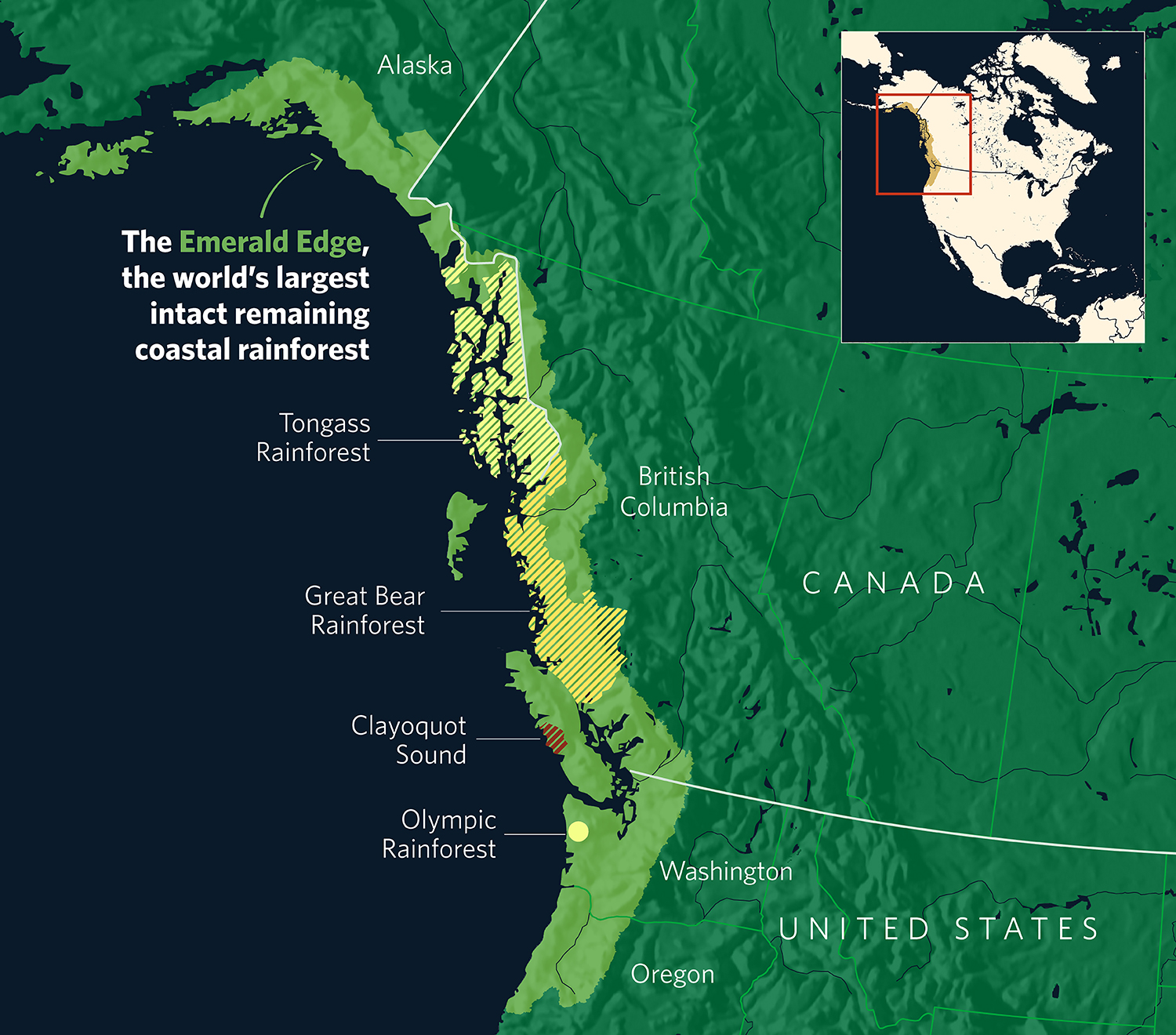
Opportunities and challenges in the Pacific Northwest rain forest, “the Emerald Edge”: as described by The Nature Conservancy, “the world’s largest coastal temperate rainforest, spanning Alaska, British Columbia, Washington state and Oregon [which] plays a critical role in regulating the global climate.”
More to come.