Index
How Soon Will We Be Redefining “Summer”?
1 September 2026
Peter Coffee
Here in the Pacific Northwest, regardless of what the calendar says, this week feels like summer’s final days. It’s looking to be markedly cooler, and wetter, than what we were seeing only two weeks ago – and we’re opening windows in the middle of the day, to warm up the house, instead of closing everything at mid-morning to keep out the heat. That change in the polarity of what we call our daily “tipover” is saying that summer’s about to be over, but that’s a hyper-local definition; it’s not what the world as a whole is experiencing.
Rather, the world is looking at a future normal understanding of a “summer” that’s longer than any official span on the calendar, whether that means now in the northern hemisphere or in coming months south of the equator.
Yes, of course, “summer” has a formal meaning: the days between summer solstice and autumnal equinox, the period starting at the moment of longest daytime for the year; ending when daylight and darkness next get equal time. Behaviorally, though, many people in the USA start “summering” on the Memorial Day holiday weekend at the end of May, and continue through early September’s Labor Day; in the UK, the period June 1 through August 31 is commonly considered “summer,” and the 24th of June (within a whisker of the astronomical start of the season) is officially designated “Midsummer Day.” (That term has a long-standing meaning as one of the four “Quarter Days,” which are often still the due dates for property rents in England. Traditions have long lives. As for the mandatory Shakespearean citation, A Midsummer Night’s Dream includes a reference to “the rite of May,” so precise consensus isn’t a thing – and a new definition may be coming soon.)
What set me off on this seasonal sojourn was a paper entitled “Changing Lengths of the Four Seasons by Global Warming” – to which my first reaction was “Don’t be ridiculous, summer is defined by the tilt of the planet.” Wouldn’t anything else be entirely subjective? Or culturally varied? It turns out, though, that there is an objective definition of summer as the period between “onset” and “withdrawal” – during which the smoothed curve of daily temperature arcs above a 75th-percentile threshold based on long-term averages over a period of many years. This has the merit of being both reasonable in terms of experience, and simple in terms of math. A researcher in Korea depicts it like this:
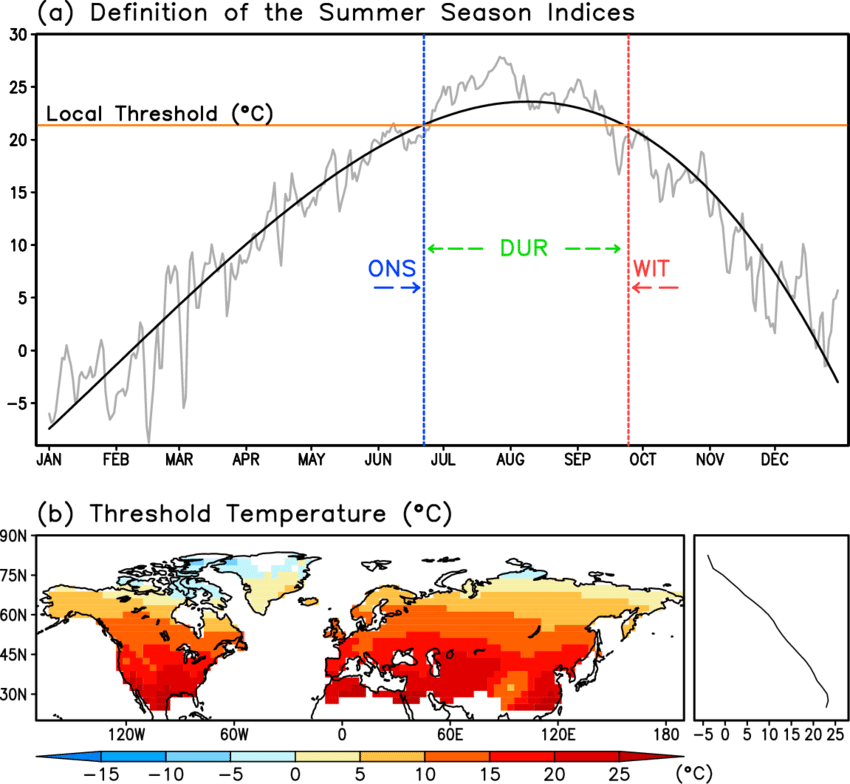
This gives us the terminology we need to understand the language of the “changing lengths” paper referenced above, which asserts that
We find that lengths and start dates of the four seasons have changed, and the changes will be amplified in the future. Over the period of 1952–2011, the length of summer increased from 78 to 95 days and that of spring, autumn and winter decreased from 124 to 115, 87 to 82, and 76 to 73 days, respectively. In addition, summer is projected to last nearly half a year, but winter less than 2 months by 2100. Such changes can trigger a chain of reactions in agriculture, policy-making for agricultural management and disaster prevention [that] requires adjustment accordingly. The seasonal-related topics involving ecology, the ocean and the atmosphere also need to be revisited.
The mild phrase “chain of reactions” seems like a massive understatement, and this is not speculative: in the time since that 2021 paper appeared, flowers and insects and other living things have made it clear that reading a calendar is not in their skill set and is not a factor in their plans. “A global study, leveraging AI to scrutinise eight million digitised plant specimens spanning a century, found that flowering has shifted by an average of 2.5 days earlier or later per decade,” reports one story (full source material available from the Royal Botanic Gardens) – while European climate change is reflected in a finding that “spring events (such as leaf unfolding) advanced by about 6 days, while autumn events (such as leaf colouring) were delayed by about 4.8 days, lengthening the average growing season by ~10.8 days since the early 1960s.”
This is not a simple matter of adjusting the seasons’ boundary dates, because different actors in the ecosystem evolve on different time scales. “This disruption poses a critical threat to the delicate relationships between plants and their vital pollinators,” noted the “2.5 days” story linked above, which is simpler language than “phenological asynchronous mismatch”:
If a tree signals its buds to burst forth before frost has left, and a bee wakes too late to find the flowers, what does that signify? As global temperatures rise and seasons change, the timing of migration, bloom, and breeding is not as it once was—and not all species can evolve fast enough to remain in sync with their host, leading to a concept that informed scientists have termed phenological mismatch…
Historically, nature has always operated like a master clock, where each organism rhythmically ticks in sync with its waiting counterpart. However, climate change has thrown the clocks out of sync, and now, we are starting to visually see it unravel, with our ecosystems suffering from the extent of this behavior.
Meanwhile, the astronomical elements of the system have no inclination to adapt to the needs of life on the Third Rock:
In eastern North America, this mismatch has resulted in native wildflowers experiencing approximately 25% less full sunlight during key photosynthetic periods as canopy trees shade them earlier in the growing season.
Extrapolation is left as an exercise for the reader – or, to quote (not my first time) the movie “The Core”: “Feel free to throw up, I know I did.” The interactions involved in the simple phrase “climate change” are always more complex than what I thought I understood – and this is a test for which there is no makeup exam, no “extra credit” opportunity available if we get it wrong the first time. Only in a surfing movie is an “Endless Summer” something to pursue.