Index
We’re Heading Into Uncharted Waters
28 April 2026
Peter Coffee
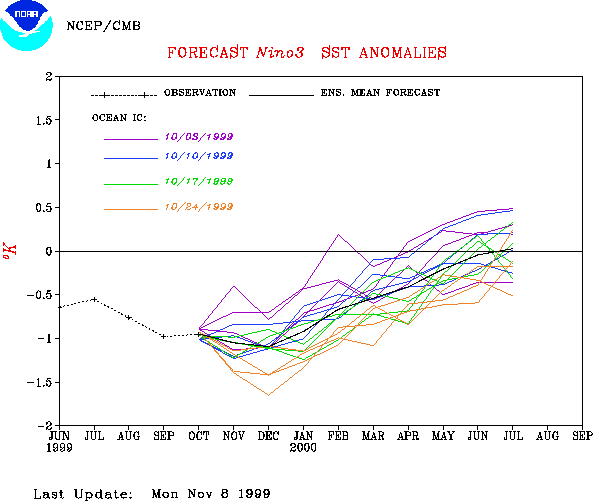
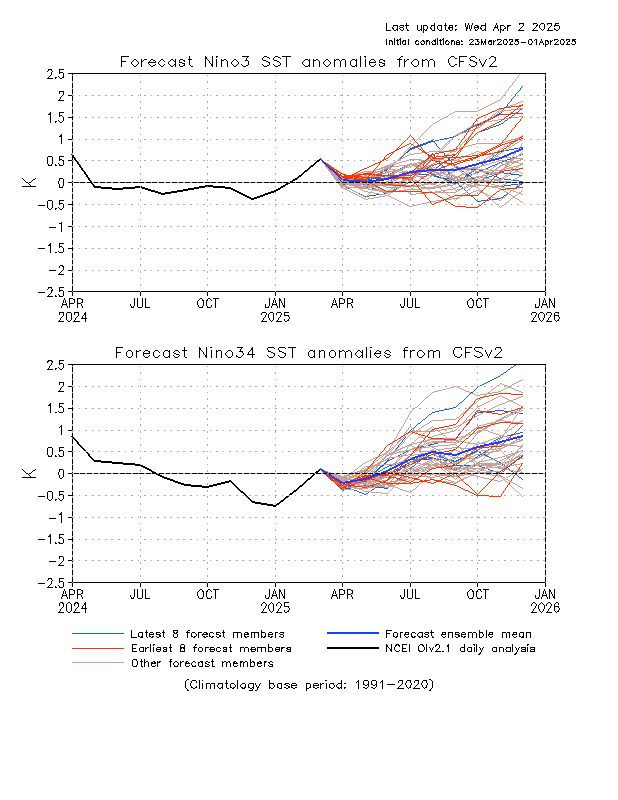
In 1999, which is the earliest year for which I can find this infographic, the “Sea Surface Temperature Anomalies” reported by the National Weather Service Climate Prediction Center were plotted with a maximum (Y-axis) value of 2 degrees Kelvin above their reference level. This makes life difficult today, when a somewhat revised format for this data plot already has a raised ceiling of 2.5ºK – but the “Forecast ensemble mean” breaks above that value after December of this year. We are heading into uncharted waters (if you’ll pardon my poetic license) – with ocean temperature projections rising so quickly that the CPC won’t be able to plot them in their monthly Climate Diagnostics Bulletin until they change their format again.
As noted here last month, temperatures are neither a complete nor an immediate measure of the climate situation: the ocean absorbs CO2, the ice caps absorb heat through phase change, and it’s only the more comprehensive measure of overall radiation imbalance that tells us in real time how quickly things are going in a bad direction.
It’s still worth noting, though, that “The past six months has seen Arctic sea ice extent ‘at record or near-record lows, alongside unusually warm conditions’” – an assessment attributed to Dr Lettie Roach, a polar climate scientist at the Alfred Wegener Institute, late last month. At the other pole, shrinking Antarctic sea ice is posing a grave threat to the Emperor Penguin, as “it looks like the ocean’s circulation has changed, and it’s almost like someone turned on the hot tap and now the bath is getting warmer” (in the words of Sarah Purkey at the Scripps Institution of Oceanography).
Parenthetically, this is also an example of the principle that it’s never just one thing: as noted in the final sentences of “discussion and conclusions” in the formal published report on these near-Antarctic water temperature measurements,
These changes may have important consequences for the global carbon cycle, particularly given that the region south of the Antarctic Circumpolar Current is known to be a net source of carbon outgassing. Altered upwelling pathways and stratification could influence both the ventilation of deep carbon-rich waters and the efficiency of biological carbon export, with potential feedbacks on atmospheric carbon levels.
Everything mentioned so far was the result of my digging further into last week’s bulletin from the World Meteorological Organization that warned,
For May–July 2026 (MJJ 2026), the Niño 3.4 plume indicates a rapid warming trend. Following the transition to neutral conditions in early 2026, the multi-model ensemble (MME) shows a nearly unanimous trajectory toward El Niño by May. By MJJ, the MME average approaches 1.5°C. The tight clustering of the models, despite the typical spring predictability barrier, underscores the high confidence in the onset of El Niño, followed by further intensification.
Underline the above with the further observation, from work supported by the National Research Foundation of Korea, that an El Niño event of the kind that’s currently anticipated may trigger “climate regime shift”:
Regime shifts are large, sudden, and persistent changes in the function and structure of natural systems. Those occurring in the climate system are referred to as climate regime shifts (CRSs). CRSs manifest across various time scales, ranging from dramatic transitions between glacial and interglacial states to more abrupt multi-year to decadal shifts, which are hard to reverse and, in some cases, irreversible.
It was the word “irreversible” that grabbed me by the brain stem, and variations on that term are showing up in many analyses of the near-term trend. Bob Berwyn at Inside Climate News corresponded with one of the authors of the Korean paper quoted above, and shared resulting notes that
There are only three super El Niños on record: in 1982-83, 1997-98 and 2015-16. All of them contributed to regime shifts in regional ocean temperatures, leading to unprecedented marine heat waves that destroyed or damaged coral reefs and caused mass die-offs and starvation among many marine organisms, from starfish to seabirds and marine mammals. Those impacts, as well as changes in drought and extreme heat over land areas, persisted for years…
The [Korean] research also uncovered strong El Niño signals in the form of soil moisture changes in central southern Asia, central Australia, the Amazon and western Greenland. If soil moisture stays below normal for several years, crops are exposed to repeated heat and water stress across multiple growing seasons.
In short, it’s not just about the penguins and the coral, although that would be quite enough to merit concern and action. It’s also about our water and our food.
Many forecasts of climate-related events talk about things that will happen in 2030, or even in 2150 – which sounds to many, I suspect, as if there’s time to think about it. When words like “irreversible” are being used, though, about things that will happen in the next ten months, perhaps the need for “emergency brakes” will get more urgent attention.