Index
Words Have Synonyms; Numbers Don’t
31 March 2026
Peter Coffee
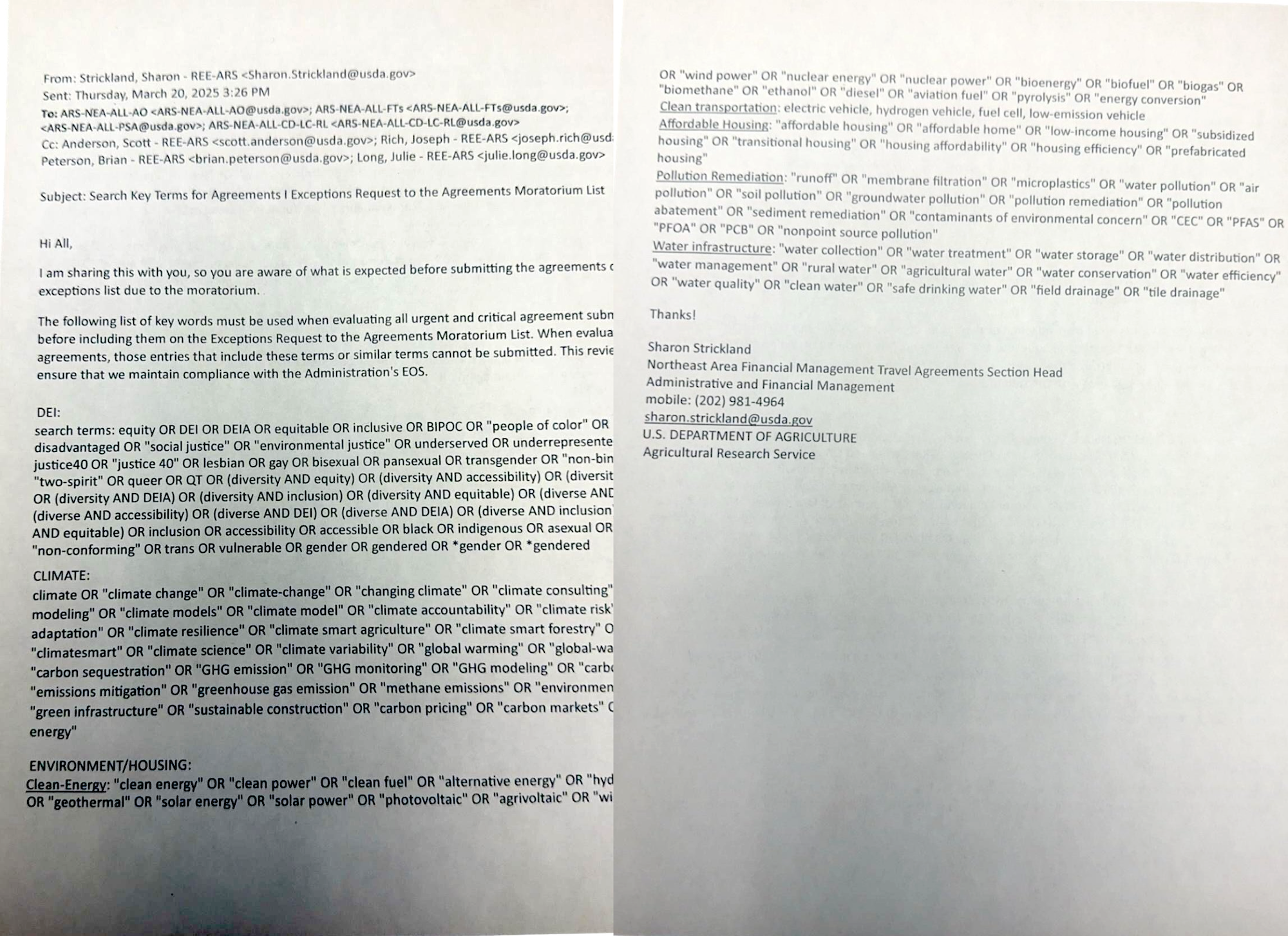
There may be an actual list of words that must not be used in describing research projects, if federal funding is desired. I’m not talking about red/blue tropes, or stereotypes that might overstate a difference of opinion or technique. I mean a March 2025 memorandum, printed out and photographed, purportedly sent from a government email account to various distribution lists and several individuals – with a subject field reading “Search Key Terms for Agreements | Exceptions Request to the Agreements Moratorium List.”
That allegedly official memo warns, “The following list of key words must be used when evaluating all urgent and critical agreement sub[missions]…those entries that include these terms or similar terms cannot be submitted.” The two major sections are labeled “DEI” (you can probably guess some Things That Must Not Be Said in that context) and “Climate” – with impermissible language including,
climate OR "climate change" OR "climate-change" OR "changing climate" OR "climate consulting"…OR "climate models" OR "climate model" OR "climate accountability" OR "climate risk”…OR "climate resilience" OR "climate smart agriculture" OR "climate smart forestry"…OR "climate science" OR "climate variability" OR "global warming" OR "carbon sequestration" OR "GH emission" OR "GHG monitoring" OR "GHG modeling"…OR "emissions mitigation" OR "greenhouse gas emission" OR "methane emissions" OR…"green infrastructure" OR "sustainable construction" OR "carbon pricing" OR "carbon markets"…
(Ellipses indicate passages that were covered by overlapping pages in the photo.)
Researchers aren’t, in general, stupid, and it appears that they have readily found restatements that get through the filters: “the number of NSF grants whose titles or abstracts mentioned ‘climate change’ fell from 889 in 2023 to 148 last year, a 77 percent plunge,” according to nonprofit media site grist.org, but Grist’s graphic of National Science Foundation data indicates that a substitute phrase “extreme weather” was used almost seventy per cent more often in 2025 than it was in 2021. We can deplore the need to play word games, but outcomes of measurement and understanding are still being achieved – even if, as reported by Grist, one professor at American University had to get funding from the Norwegian Policy Council to study federal climate-related policymaking in the United States.
Words, it’s thus apparent, have synonyms, but numbers are what they are – so it’s perhaps a bigger problem if we try to make numbers say what we wish were true, instead of using them to measure what is. A current example of choosing math that gives a desired answer is a legislative debate about the time scale for calculating the climate impact of methane – and yes, I realize that CH4 has been coming up a lot lately here, but please bear with me.
The state of New York, in the person of governor Kathy Hochul, is reviving a 2023 proposal to account for Global Warming Potential (GWP) on a time scale of one hundred years rather than twenty years. Why would this seemingly technical detail be worth anyone’s effort to change? Because a 100-year calculation makes for a huge reduction of methane’s effect, since methane is removed from the atmosphere by relatively rapid reactions. If methane effect is calculated on a 100-year scale instead of a 20-year scale, then methane emissions today can be made to look like a much smaller relative problem, since the 100-year method is plugging in a time span that’s five times as long for that natural scavenging to take place.
The resulting lowering of methane’s GWP number would allow a slower pace of retiring or repairing methane-emitting natural gas infrastructure, while still achieving mandates for greenhouse-effect mitigation. Or should “achieving” come with big fat air quotes?
There’s an open letter to New York State leadership (from more than five dozen researchers and practitioners at Cornell, Stanford, MIT, and other centers and partnerships) that challenges the proposed change of method, observing that “at the 100-year timescale, a pound of methane is 29.8 (GWP-100) times more potent than a pound of carbon dioxide, but at the 20-year time scale, that same pound of methane is 82.5 (GWP-20) times more potent than a pound of carbon dioxide at trapping heat.” The researchers then note that “over the past 10 to 15 years, the science on methane as a driver of climate disruption has become much stronger”; they review the history of prior use of a 100-year time scale, back in the 1990s, and call attention to a 2013 update from the Intergovernmental Panel on Climate Change that “clearly stated that the use of a 100-year time period was ‘arbitrary’…[and that] the IPCC has recommended selecting a time frame for methane appropriate to the concern.”
From that same open letter,
GWP-100 does a terrible job of representing the climatic damage caused by methane…understating the effect of any new methane emission source by a factor of 4-5 over the 20 years following the introduction of the new source… If we brought the human-caused methane emissions rate to zero today, in less than 20 years, we would have reduced global warming from methane and CO2 emissions by 40% - it would take over 100 years to do the same with an equivalent decrease in CO2 emissions. The use of GWP-100 hugely underestimates this impact and suggests far less urgency to reduce methane emissions.
Governor Hochul isn’t trying to hide her rationale for making methane emissions seem to be less of a problem, or for finding political cover to cut those emissions much less quickly. “Absent changes to the law,” she writes, “the New York State Energy Research and Development Authority found the impact of meeting the Climate Act’s 2030 targets would be staggering – more than $4,000 a year for upstate oil and natural gas households, and $2,300 more for New York City natural gas households. And gas prices at the pump would jump an additional $2.23 per gallon above where it would otherwise be. As Governor, I can’t let that happen.” Well, that says the quiet part out loud, doesn’t it? When elections happen every few years, even a 20-year projection might seem so distant that it can be (and must be?) ignored.
Word games may be sadly necessary to get some good things done, but numbers games like these can prevent the right things from getting done. It’s not just about the value of a number, but also about its shape: The Climate Brink distinguishes methane from CO2 by calling the former a “flow” pollutant (“its climate effect is a function of the rate of emissions”) while the latter is a “stock” pollutant (“whose impacts are a function of cumulative emissions”). It follows that cutting new emissions of CO2 takes a long time to make a difference, while cutting new methane emissions has far more rapid benefits. These are simple facts that can be described by simple numbers – and unlike the euphemisms that are being found to evade the “Moratorium List” in government research funding requests, the numbers of climate chemistry are implacable; the costs of policy choices are matters of math.
What we collectively “can’t let happen” over the next twenty years, or the next hundred years, are legitimate topics of debate – but let’s debate from a starting point of reality, rather than working backwards from what we’d prefer to be told.